
Inside Covington Tax Records
Two tools carry Covington County property tax records. The Revenue Commissioner runs a tax service organized by tax year and search terms. The AlabamaGIS parcel card holds the property facts. There you find land value, improvement value, total appraised value, exemption code, tax district, yearly tax, and payment history. Together they explain the charge. The same office appraises, assesses, collects, and disburses. When an online result needs explanation, the Revenue Commissioner is the office to call.
| Field | What It Shows | Where |
|---|---|---|
| Land and improvements | Separate parts of the total appraised value | AlabamaGIS parcel card |
| Tax class and exemption | Signals the ratio and relief used in the account | GIS and Revenue office |
| Yearly tax | Annual parcel charge displayed by the GIS card | AlabamaGIS |
| Bill and payment status | Tax-year account result and payment route | Covington Revenue search |
| Tax district | The local district assigned to the parcel | AlabamaGIS |
Keep these figures separate. Appraised value is the county's full-value estimate used for assessment. Assessed value appears after Alabama applies the class percentage. Exemptions then reduce the amount before the final tax is figured. A tax charge is not a sale price. A deed's consideration language may not match open-market value, so use the Covington County property value reference for what each label means.
Search Covington Tax Accounts
The official Covington Revenue property search is separate from the GIS viewer. Its public screen shows Tax Year, Search Type, Search Terms, and Subdivision controls. Trust only the fields shown. Dropdown choices and result columns should never be assumed. Start with the most exact term available. Change only one part if no result appears.
| Portal field | Control | Use |
|---|---|---|
| Tax Year | Select | Choose the account year being checked |
| Search Type | Select | Sets how the search term is read |
| Search Terms | Text | Enter the selected parcel or party clue |
| Subdivision | Select | Narrow a result when the recorded subdivision is known |
The official Revenue screen is the entry point for a Covington County tax search, showing Tax Year, Search Type, Search Terms, and Subdivision where the lookup begins. The county's live page is the source.
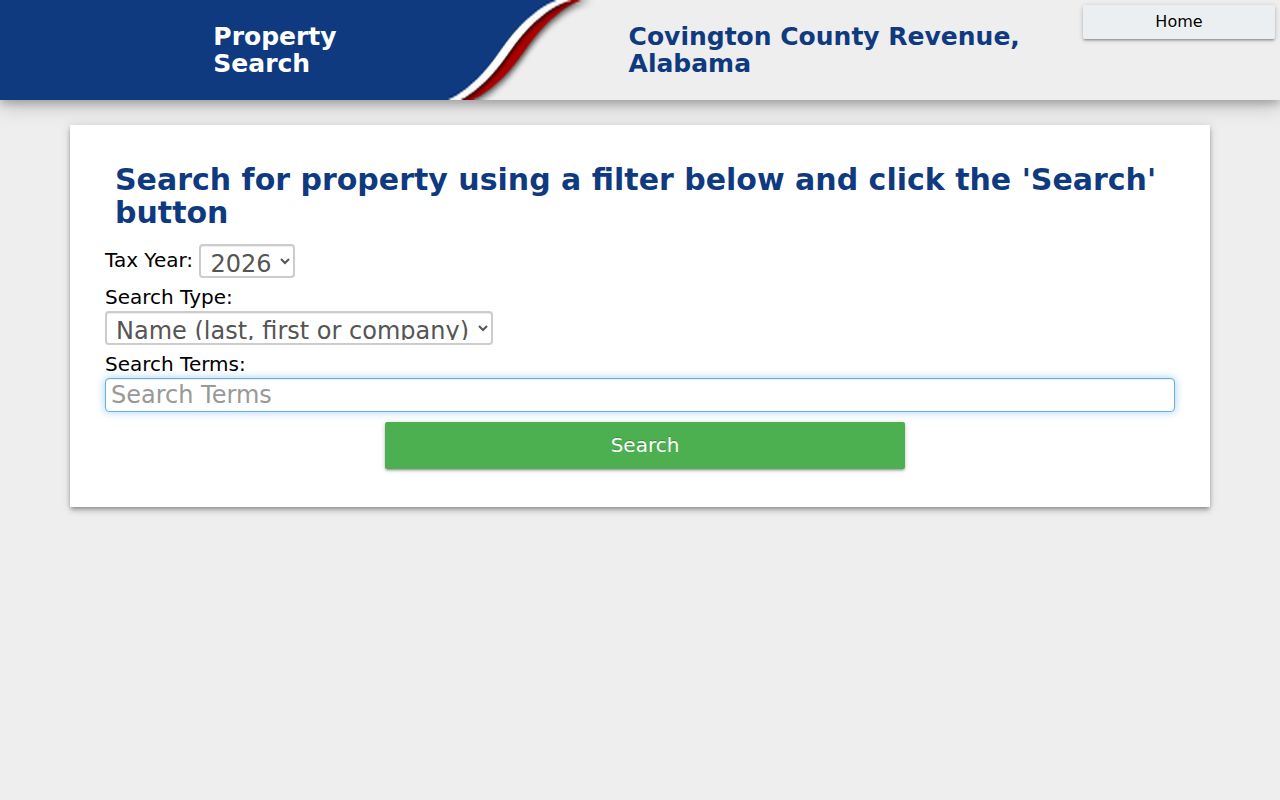
The image shows the entry fields only. No sample account result appears. For a missing parcel, receipt, bill, or assessment sheet, contact the Revenue office.
Covington Property Tax Math
The Alabama Department of Revenue assessment page states the sequence plainly. Appraised value times the class percentage gives assessed value. Assessed value times millage gives the unadjusted tax, and exemptions then reduce the result. Class III covers agricultural and forest property, owner-occupied single-family homes, and qualified historic property. Its assessment ratio is 10 percent. Other classes use different ratios. Class I utilities sit at 30 percent, Class II property not otherwise classified at 20 percent, and Class IV private passenger vehicles and pickups at 15 percent. The classification and exemption shown for the parcel control. A broad county rule cannot replace the account sheet.
- Appraised value
- The county’s estimate of full property value for assessment.
- Assessed value
- Appraised value after the applicable class percentage is applied.
- Millage
- The tax rate applied to assessed value.
- Tax lien
- A claim tied to unpaid property tax, not immediate ownership of the land.
Covington Exemption File
Covington County publishes forms and notices for regular homestead, over-65, disability, current-use, personal-use or second-home, and grain-bin matters. The county exemption-services notice puts it simply. The owner or deed holder applies. The county takes applications all year, though the benefit may apply to the next tax year, and its materials tie key filing facts to December 31 and the applicable lien date.
The regular homestead affidavit asks plenty. It wants the tax year, parcel, PPIN, deeded owner name, mailing and physical addresses, purchase and occupancy dates, contact details, signatures, and notarization. That detail helps when preparing an office visit. It does not prove an exemption was granted. Check the live account. Ask the Revenue Commissioner to confirm the effective year.
Note: A GIS exemption code is only a signal; the Revenue office file controls the parcel's current exemption treatment.
Retrieve a Covington Tax Bill
A Covington County property tax lookup works best when the address, parcel number, PPIN, account, and tax year stay separate. AlabamaGIS distinguishes those identifiers. Copy them exactly before opening the Revenue service. When the online account runs thin, the Revenue Commissioner can email bills, receipts, and assessment sheets. Paper notice from the county continues meanwhile.
- Find the parcel in AlabamaGIS and copy its parcel number, PPIN, account, tax district, and displayed yearly tax.
- Open the Revenue property search, select the right tax year and search type, then enter the matching term.
- Compare the returned bill or status with the GIS payment history and exemption signal. Treat mismatches as a reason to call the office.
- Ask Revenue for a bill, receipt, or assessment sheet when no online record appears. For older or delinquent accounts, ask which official list applies.
The Revenue Commissioner's office sits at 1 N. Court Square in Andalusia. It opens Monday through Friday. Hours are 8 a.m. to 5 p.m., and the phone number is 334-428-2540. Mapping & Appraisal, at 220 Hillcrest Drive, Room 154, handles parcel mapping and appraisal data at 334-428-2630.
Covington’s Seven Percent Cap
Alabama's Act 2024-344 information sets a cap on how fast taxable assessed value can rise each year for eligible Class II and Class III real property. The base year is October 1, 2024. Collections under the cap start October 1, 2025. Keep one point straight here. This caps growth in taxable assessed value; it does not freeze fair market value.
Several situations fall outside the cap. Classification changes do. Most ownership changes and newly assessed property do too. New improvements and tax-increment districts can also sit outside the cap, subject to the statutory exceptions listed. Over time, a gap can open between a parcel's fair assessed value and its capped taxable assessed value. That gap explains why two figures on the same Covington County property tax record can serve different purposes.
The official appeal page makes one point plainly. The Board of Equalization still hears fair-market-value disputes even when the cap holds down the taxable figure.
The state explanation helps you name the issue to raise on a Covington County property tax record. Covington Revenue supplies the parcel's current figures and the local filing instructions you need.
Covington Delinquent Tax Trail
Alabama property taxes become due October 1 and delinquent after December 31. Covington County has declared a tax-lien auction for delinquent real property. The auction runs under the Title 40 process. County commission minutes show the 2024 unpaid-tax sale was set for May 21 through GovEase. Bidder registration and certification were required. Treat that dated event as history. It is not a current parcel listing.
The ALDOR delinquent-property page separates county listings from state-held certificates. Some lists omit a physical address. Match the parcel number and legal description rather than a name alone. Covington's state-held land-sales notice says a quote is emailed. It gives ten calendar days to remit. It also warns that neither a certificate nor a tax deed provides clear title. Bid accordingly.
Tax-sale limit. Paying a delinquent tax claim does not by itself create clear ownership; redemption, notice, prior liens, and title defects still require review.
Protest Covington Tax Assessments
The ALDOR real-property FAQ gives a property owner 30 days after receiving written valuation notice to file a written protest with the County Board of Equalization. Covington's Revenue Commissioner publishes no county-specific protest form, annual hearing dates, or local notice calendar online. Get the current form from that office. Get delivery instructions there too rather than relying on an old date.
Strong evidence helps at the hearing. Bring the county assessment sheet, photos and facts about the property's condition, a survey or corrected land area, and recent arm's-length sales. Documents showing an incorrect class or exemption also count. Keep proof of delivery. Alabama's separate 60-day route for state final assessments does not govern an ordinary county real-property valuation protest.
Appeal window. File the written Covington County valuation protest within 30 days after the written notice, and confirm the current local process with Revenue.