
Covington Property Value Types
A Covington County property value can mean several different things. AlabamaGIS splits the figure into land value, building or improvement value, and total appraised value. State law then applies a class percentage. That produces the assessed value. Taxable assessed value may drop further after exemptions or the state's annual growth cap. Deed records and Real Estate Sales Validation Forms offer consideration clues. The county publishes no public sale-price history field.
| Value | What It Is | Where |
|---|---|---|
| Appraised value | County estimate of full value for assessment | AlabamaGIS or assessment sheet |
| Assessed value | Appraised value times the Alabama class ratio | Revenue assessment record |
| Taxable assessed value | Tax base after applicable rules and relief | Revenue office |
| Sale consideration | Value language tied to a recorded transfer | Deed or validation form |
| Land and improvements | Parts that make up total appraised value | AlabamaGIS parcel card |
Class drives the math. A typical owner-occupied single-family Class III parcel uses a 10 percent ratio. Class II property not otherwise classified uses 20 percent. Class I utilities use 30 percent. Class IV private passenger vehicles and pickups use 15 percent. The parcel's actual class controls, so check it before comparing anything. This ratio is why assessed value can sit far below appraised value. It does so without any loss of market worth.
Covington GIS Value Fields
One sample AlabamaGIS card separates land at $5,500. Building and improvements sit at $159,640. Total appraised value comes to $165,140. It also lists a 2025 yearly tax of $477.94 plus an exemption code. Those numbers describe a single parcel. Do not generalize them to a neighborhood or to the county. The detail card adds building use, year built, and square footage. Rooms, story count, class, condition, land units, and other improvements appear there too. Those facts explain the appraised components. They remain mass-appraisal inputs. A physical change or a mapping correction may need direct review. An omitted condition issue may need it as well, so contact Mapping & Appraisal. Note: Compare values from the same tax year, since the public GIS build date does not establish when every parcel was last inspected.
Alabama Ratios Shape Covington Values
The ALDOR assessment explanation lays out the formula plainly. Multiply appraised value by the classification percentage to get assessed value. Multiply assessed value by millage for unadjusted tax. Then subtract exemptions as applicable. That sequence keeps the meaning of an appraisal separate from the bill itself.
- Appraised value
- The county’s full-value estimate for assessment.
- Assessed value
- Appraised value after the class ratio.
- Assessment ratio
- The state percentage assigned to a property class.
- Consideration
- Value language connected to a transfer, which may not equal market price.
- Reassessment
- A later review or update of the property’s roll value.
Read the class and exemption status from the parcel's official account, not from memory. The GIS sample shows no separately labeled assessed-value field. So skip the parcel-specific math until you confirm the class and the current assessment sheet.
Find a Covington Property Value
Start with the physical address in Covington AlabamaGIS. The viewer separates street number from street name. It also searches by owner, parcel, account, district, subdivision, acreage, or value range. Before reading any value fields, match the site address, parcel, PPIN, account, district, and newest deed reference against the deed records you already hold.
- Enter the physical street number and name. Simplify a suffix or directional only if the exact query fails.
- Open the correct parcel card and record its year, land value, improvements, total appraised value, exemption, and district.
- Ask Covington Revenue for the assessment sheet to confirm class, assessed value, exemption, and taxable figure.
- Read the newest deed or validation record for consideration clues. Do not label one as a market sale without support.
The Revenue Commissioner emails assessment sheets, bills, and receipts, and paper notice continues. The office sits at 1 N. Court Square, Andalusia, reachable at 334-428-2540. Mapping & Appraisal occupies 220 Hillcrest Drive, Room 154, at 334-428-2630.
Covington’s Capped Taxable Value
Act 2024-344 guidance now caps taxable assessed value. The cap limits annual increases to 7 percent. It applies to eligible Class II and III real property. The base took effect October 1, 2024, for collections beginning October 1, 2025. It does not cap fair market value. It also does not promise every parcel qualifies.
Classification changes and most ownership changes can fall outside the cap. So can newly assessed property, new improvements, and tax-increment districts. Listed exceptions still apply. A gap can therefore open between true assessed value and capped taxable assessed value. The Board of Equalization still hears disputes over fair market value. Read both numbers before drawing any conclusion.
The official state screen below frames that distinction and the continuing appeal route.
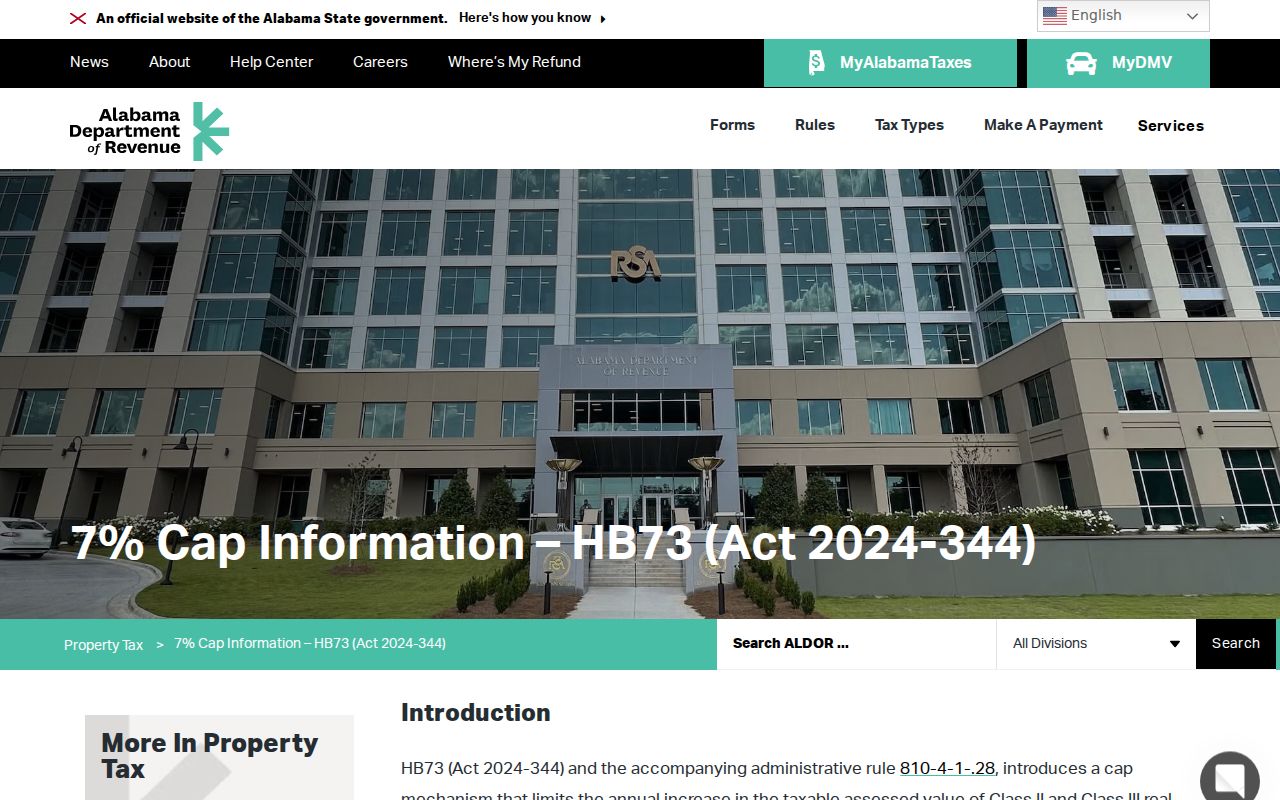
The image states the state rule, while the Covington Revenue record supplies the parcel-specific class and values.
Covington Deeds Give Value Clues
Covington requires a Real Estate Sales Validation Form with each deed. The county says the form contains property value used to assess deed tax. The recorded deed may add consideration language. Neither source proves an arm's-length market price on its own. Family transfers can distort the number. Partial interests, nominal consideration, or bundled land can make it impossible to compare. The public GIS shows deed book, page, and date but no verified sale-price history. For a closer look, search the ING Covington Probate portal by that citation. Then inspect the instrument itself. Index viewing is free. Document downloads use a paid route.
Exemptions Alter Covington Tax Value
Homestead and other relief can change the taxable result. It does not touch the appraised figure behind it. Covington County materials cover regular homestead, over-65, disability, current use, personal-use or second-home matters. They also cover grain-bin matters. The owner or deed holder applies. Year-round applications may take effect in a later tax year, so timing matters.
An exemption code on the GIS card is only a clue. The Covington exemption notice and the Revenue office control the real answer. That is why a lower bill does not by itself establish a lower property value. Delinquency and the protest route follow a separate path. The Covington County property tax records page carries the full tax process.
Covington Value Trend Gap
Covington County publishes no revaluation study, neighborhood sales set, or countywide value-trend report. The assessor also offers no parcel-comparable display for public use. The GIS build carries a December 29, 2025 date. That stamp does not tell you when any single property was last reviewed. One parcel card is a snapshot, not a market trend. Treat it accordingly. For real context, pull recent arm's-length deeds for genuinely similar property. Keep the transaction terms intact. When a present market opinion matters, get a professional appraisal. Census owner-value figures are aggregate estimates. They cannot replace a parcel assessment or a deed record.
Covington Property Value Limits
The assessor's number exists to support taxation. It is not a promise of sale proceeds. It is not a broker's opinion, a lender's appraisal, a title opinion, or a survey. Market conditions and the condition of a property can shift faster than the tax roll updates. Even a recent deed in the Covington County deed records may reflect terms that keep its consideration from being a clean comparable.
Use county property records to understand the official assessment, plain and simple. For a current, parcel-specific market opinion, turn to a licensed appraiser. For ownership, rely on the latest deed and full title work.
Value vs price. A Covington County assessed value serves taxation and is not a forecast of sale price or a licensed appraisal.